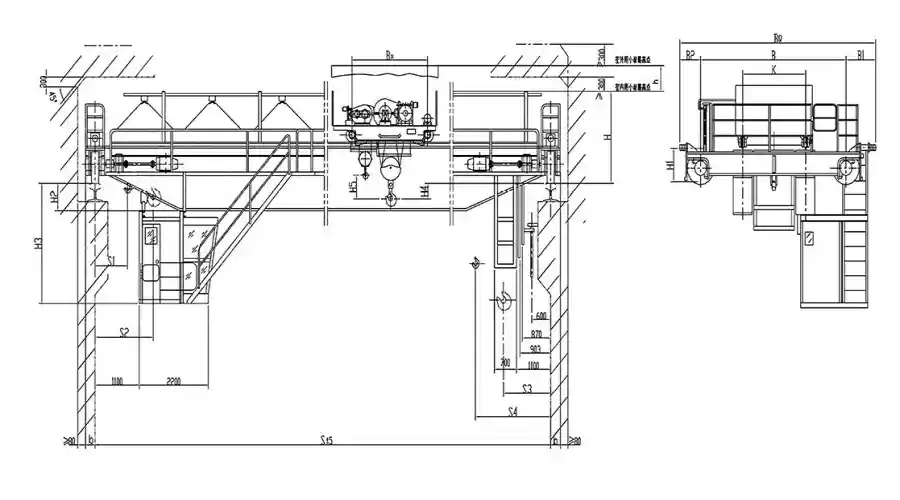
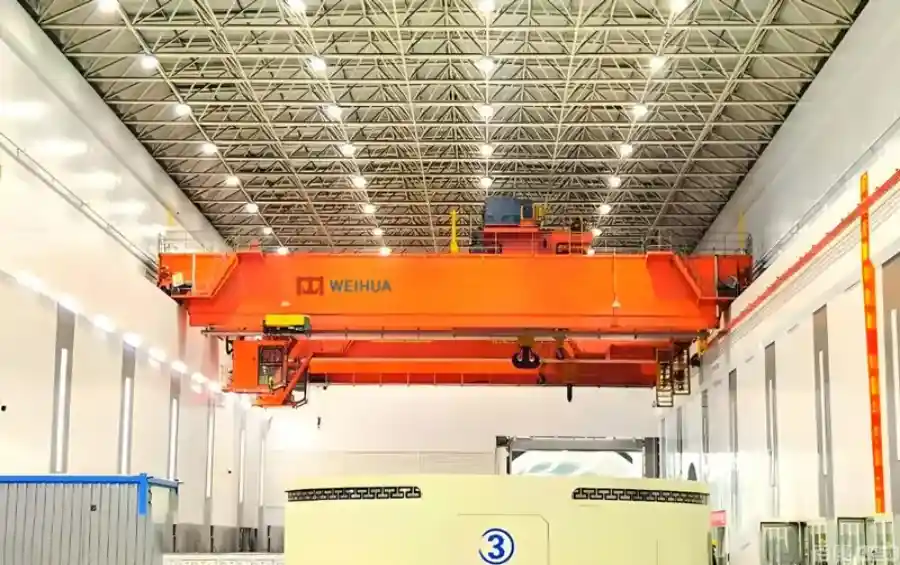
An explosion-proof bridge crane is a QB type double-girder crane built to JB/T 5897-2006, with every component modified to eliminate potential ignition sources. It serves facilities where flammable gases, vapors, or combustible dust are present — chemical plants, oil refineries, paint shops, coal processing, and grain handling.
The starting point for specification is not the capacity or span. It is the hazard zone classification of the facility. That classification determines which explosion-proof grade the crane must meet, what materials the wheels and sheaves must be made from, and what type of electrical enclosures are acceptable.
Seven Differences Between a QB Explosion-Proof Crane and a Standard QD
| Area | Standard QD | QB Explosion-Proof |
| Motors | Open drip-proof or TEFC | Dedicated explosion-proof motors, Class F insulation, IP44, self-braking |
| Wheels & sheaves | Carbon steel | Stainless steel or copper alloy on tread and flange to eliminate friction sparks |
| Electrical enclosures | Standard industrial | Flameproof — any internal spark is contained and cannot ignite surrounding atmosphere |
| Braking | Single brake per mechanism | Support brake (flameproof on motor high-speed shaft) + electrical control braking. Two independent methods per mechanism |
| Speed control | Across-the-line start | VFD or rotor resistance for smooth start/stop — prevents mechanical shock that could generate sparks |
| Anti-static design | Not required | Full grounding circuit across the hoist mechanism to prevent static charge buildup |
| Overload/limit | Single limit switch per motion | Dual limit switches on hoist + overload sensors + emergency stop on all control stations |
Explosion-Proof Grades — ExdIIBT4 vs ExdIICT4
IIC covers everything IIB covers plus the most easily ignited gases. When the facility handles hydrogen or acetylene, the crane must be specified as dIICT4.
Hazard zone classification: - Zone 0/20 (gas or dust present continuously) → dIICT4 required - Zone 1/21 (gas or dust likely during normal operation) → dIIBT4 or dIICT4, depending on the specific gas - Zone 2/22 (gas or dust unlikely but possible) → full machine certification still required
Important: Some suppliers offer “explosion-proof accessories” on standard cranes. For true hazardous areas, insist on full machine compliance — every component certified, not only the motor. Weihua’s manufacture license (TS2410A21-2020) covers QB explosion-proof bridge cranes up to 100t at dIICT4.
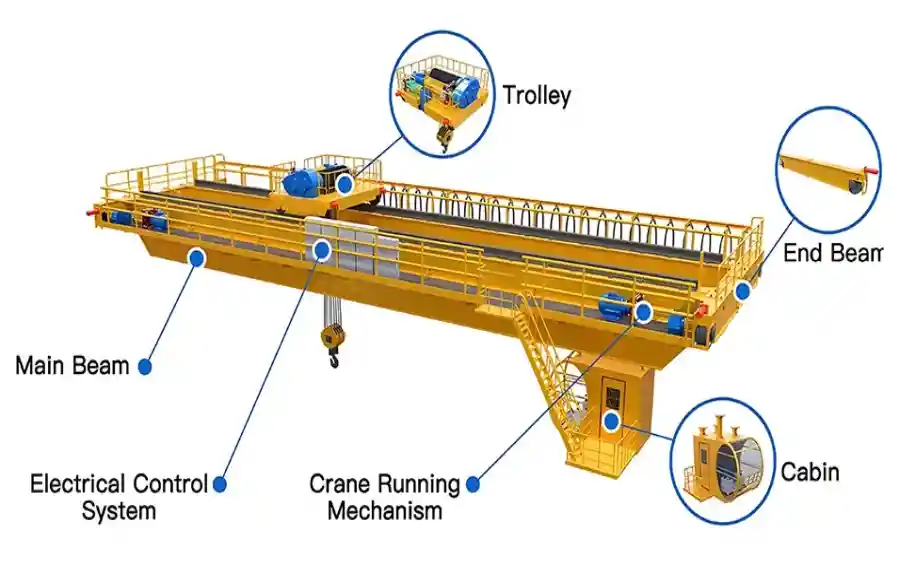
Structural Design — Box Girder, Finite Element Analysis
The QB explosion-proof bridge crane uses a double-girder, double-rail configuration. The main girder is a positive-track box section verified by ANSYS finite element analysis.
•Girder material: Q235-B or Q345-B steel, minimum plate thickness 6 mm
•Camber: 1/1000 to 1.4/1000 of span; maximum camber point within mid-span 1/10 zone
•End carriage: Box section, rigidly connected. High-strength bolted joints with reamed bolt holes, match-marked at the factory
•Walkway: Anti-skid checkered plate, 3 mm thick. Handrail at 1050 mm with 350 mm horizontal bar spacing and 70 mm toe plate
•Welding: Submerged arc or gas-shielded for butt and fillet welds. Non-destructive testing (NDT) after welding
Control and Operation
Three control methods are available:
•Ground pendant — Operator beside the load. Most economical for short-travel applications.
•Wireless remote — Operator carries a handheld transmitter within line of sight. Preferred when the crane covers a large work area.
•Cabin control — Enclosed or open cabin mounted on the bridge. Specified when the operator needs an elevated view of the load.
All control stations include emergency stop and anti-static grounding. The VFD option adds stepless speed control for smooth acceleration — critical when handling sensitive loads near hazardous areas.
Every certified explosion-proof crane carries a permanent nameplate listing the explosion-proof grade (e.g. ExdIICT4), certificate number, and applicable standards. Inspectors check this nameplate during commissioning and periodic audits.
Information Needed for a Quotation
1.Rated capacity (t) — Include main hoist and, if applicable, auxiliary hoist
2.Hazard zone classification — Zone 1 or Zone 2; gas group IIB or IIC
3.Span (m) — Distance between rail centers
4.Lifting height (m) — Floor to hook at highest position
5.Working duty — A4–A5 standard; A6–A7 for heavy cycles
6.Ambient temperature range — Standard -20°C to +40°C; special if outside this range
7.Control method — Pendant, remote, or cabin
8.Speed control — Standard or VFD for stepless operation
9.Power supply — 380 V 50 Hz 3-phase standard; other voltages available
Frequently Asked Questions
Q1: Can a standard bridge crane be used in a Zone 2 hazardous area?
No. A standard bridge crane lacks explosion-proof motors, flameproof enclosures, and non-sparking materials. It must be a certified explosion-proof bridge crane with full machine compliance.
Q2: What is the difference between ExdIIBT4 and ExdIICT4?
IIB covers most industrial gases (propane, ethylene). IIC covers hydrogen and acetylene — the most easily ignited gases. IIC is the higher protection level and also covers IIB-rated gases. When in doubt, specify IIC.
Q3: What is the working temperature range?
-20°C to +40°C standard. Below this range, low-temperature steel, cold-resistant lubricants, and appropriately rated electrical enclosures are required.
Q4: What materials prevent sparking on wheels and sheaves?
The tread and flange surfaces that contact the rail are stainless steel or copper alloy. Carbon steel is not permitted in explosion-proof cranes.
Q5: What certificate does Weihua hold for explosion-proof bridge cranes?
Weihua holds a Chinese Special Equipment Manufacture License (TS2410A21-2020) covering QB type up to 100t at dIICT4. The company also holds CE, TÜV, and other international certifications.